
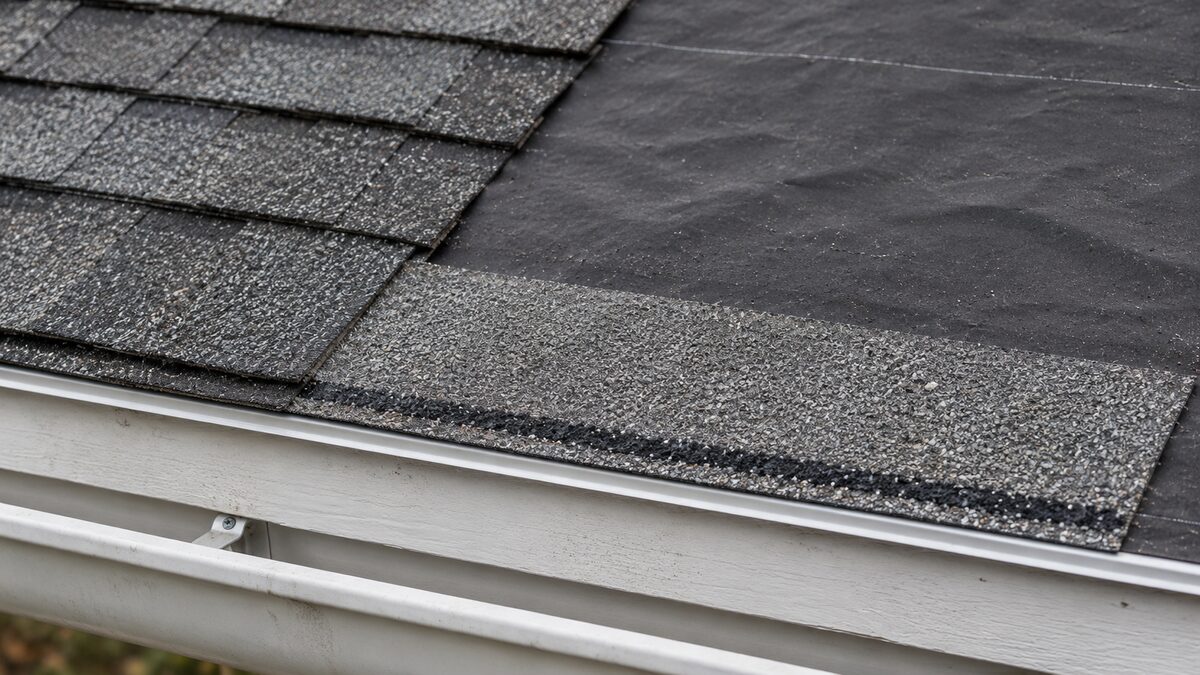
Starter shingles form the starting layer beneath the field shingles at the edges of an asphalt-shingle roof. At the eaves, this layer backs the joints in the first visible row. A correctly positioned sealant also helps secure the overlying shingles at the roof perimeter.
When reviewing a replacement proposal, it is easy to focus on the main shingle’s color and style. The edge details deserve attention too. Ask what the contractor plans to install beneath that first course and how it will work with the rest of the roof system.
These five helpful facts explain starter shingles, their placement, and the questions homeowners in Arlington and Northern Virginia can ask before a roof replacement.
1. Starter Shingles Form a Separate Starting Course
A starter course is a distinct layer installed before the visible field shingles. In a typical installation, most of it is covered when the roofing is complete. IKO’s guide to starter shingles explains this relationship between the starting layer and the finished roof surface.
Factory-made starter shingles commonly come as strips with an adhesive positioned for use at the edge. Some are supplied as perforated pieces that separate into two starter strips. Owens Corning’s Starter Strip Plus is one example.
The first visible row of regular shingles is therefore not the same thing as the starter course beneath it. When a proposal says “first course,” ask which layer the contractor means.
You may also see the terms starter strip, starter course, or a specific product name in the scope. Clarify the material and method behind the wording. A detailed proposal should make it possible to connect the installed edge detail with the selected roofing system.
2. Starter Shingles Belong Along the Specified Roof Edges
The eaves are the lower edges where water runs off the roof. Rakes are the sloping edges along a gable. These are the perimeter areas addressed by starter installation details. GAF’s Pro-Start instructions, for example, provide directions for both eaves and rakes.
At an eave, the starter course sits beneath the first row of field shingles. Along a rake, a specified starter strip runs beneath the ends of the shingle courses. The exact arrangement should follow the instructions for the products being installed.
Ask the contractor to identify the applicable edges on a roof drawing or measurement report. Include porch, garage, and addition roofs that are part of the replacement scope.
Placement Includes More Than Choosing an Edge
Starter shingles must also be positioned and fastened correctly. The manufacturer’s detail addresses matters such as overhang, joints, nail placement, and the connection between eave and rake strips. For example, GAF specifies that starter joints should not align with the joints or tab cutouts of the first course above them.
The practical question is: “Which installation instructions will the crew follow for this starter and field-shingle combination?”
3. They Provide Joint Coverage and Help Secure Shingle Edges
Starter shingles have two related functions, and their importance depends on their location.
Backing the First-Course Joints
At the eave, the starter layer provides coverage beneath the end joints in the first course of field shingles. IKO identifies this backing as part of a correctly installed asphalt-shingle roof because those joints need protection against water entry.
This explains why simply beginning with the visible shingles does not provide the same edge detail.
Supporting Wind Resistance at the Perimeter
The starter’s adhesive helps bond the overlying shingle edges. GAF describes its factory-positioned adhesive as helping reduce blow-offs at eaves and rakes. Owens Corning similarly identifies the seal between its starter strip and the first course as a product function.
Starter shingles contribute to the roof system’s wind resistance alongside the field shingles, fastening, and sealing details. The installed components need to work together.
Weather can also affect installation requirements. Owens Corning’s Duration instructions, for example, include additional perimeter sealing requirements for cold-weather installation. Ask the contractor whether the selected products and expected conditions call for additional sealing work.
4. Starter Shingles, Field Shingles, and Drip Edge Have Different Jobs
These components work together at the perimeter, but their names describe different parts of the roof:
| Component | Typical Location | Main Role |
|---|---|---|
| Starter shingles | Beneath field shingles along specified perimeter edges | Back the first-course joints at eaves and provide the specified edge-sealing detail. |
| Field shingles | Overlapping courses across the roof slopes | Form the main visible, water-shedding roof covering. |
| Metal drip edge | Along roof edges, integrated with the roofing and underlayment | Direct runoff away from vulnerable roof-edge materials. |
The distinction between the starter and visible courses is reflected in Owens Corning’s installation instructions, which address them separately. GAF describes metal drip edge as flashing that directs water away from the roof edge.
ARMA’s drip-edge guidance explains its role in shedding water and reducing the potential for supporting wood to become wet. The metal profile and its relationship to the surrounding roof layers affect the installation detail.
An estimate that includes drip edge should still identify the starter-course approach. Likewise, a starter line item does not explain what metal edge flashing will be provided.
Underlayment and ice-and-water barriers are additional components with their own roles. GAF lists starter strips, roof-deck protection, and leak barriers separately within its roofing system. Ask how those materials will be coordinated rather than treating one as a substitute for another.
5. Your Proposal Should Identify the Product, Placement, and Coverage
A useful proposal identifies which starter product or manufacturer-approved method will be used and where it will be installed. When reviewing an asphalt roofing replacement proposal, ask for enough detail to understand the planned edge construction.
| Question to Ask | What the Answer Should Clarify |
|---|---|
| Which starter product or approved method is included? | The material and installation approach being proposed. |
| Is it suitable for the selected field shingles? | Compatibility with the chosen shingle style and dimensions. |
| Which eaves and rakes are included? | The applicable edges on each roof section within the project scope. |
| How was the quantity determined? | The edge lengths, product coverage, and allowances used for ordering. |
| Which instructions govern the work? | The product-specific placement, fastening, and sealing requirements. |
| Can installation photographs be provided? | A record of the edge detail before the field shingles cover it. |
Confirm Product Compatibility
Starter shingles should be selected for the chosen field shingles. GAF describes Pro-Start as compatible with most of its shingle lines, while other starter products accommodate additional designs. Owens Corning also identifies an exposure limit for Starter Strip Plus. These product differences make the exact material name useful.
If the contractor proposes an alternative, ask for the applicable manufacturer instructions and an explanation of how that alternative satisfies them.
Review Edge Lengths and Package Coverage
Quantities of starter shingles are based on the linear length of the edges receiving the material. Roof area alone does not establish that quantity. IKO explains that the applicable eave and rake lengths must be compared with the starter product’s published linear coverage.
Ask how the estimate accounts for those lengths and any cutting or package allowances. Two proposals may present quantities differently, so compare the included work before drawing conclusions from the number of bundles.
Keep a Record of the Covered Work
Ask for the product information and a few installation photographs before the starting layer is covered. This gives you a more useful record than relying only on the finished roof’s appearance.
If the estimate uses a broad phrase such as “roofing accessories,” request clarification about whether starter shingles are included. The absence of a separate line item does not, by itself, prove that the material has been omitted.
Frequently Asked Questions About Starter Shingles
Do Architectural Shingles Need a Starter Course?
Yes. Architectural shingles still need the starter detail specified for their system. Owens Corning’s Duration instructions, for example, describe a starter course separately from the first field-shingle course. Confirm the appropriate product or approved method with the contractor.
Can Regular Shingles Be Cut to Make a Starter?
Sometimes, when the manufacturer permits a specific method. Owens Corning’s current Duration instructions include an approved field-starter method. That is not permission to substitute any shingle or use a generic cutting pattern. Ask which instructions support the proposed approach.
Can I Confirm the Installation From the Ground?
Usually, a ground-level view cannot verify the complete starter detail because much of it is covered by field shingles. Use installation photographs and product records, and have a professional assess the edge if questions remain. The finished appearance alone cannot establish the hidden fastening or product choice.
Do Loose Shingles at the Edge Prove the Starter Is Missing?
No. That observation calls for an inspection of the edge assembly. Ask the contractor to document the findings and explain any recommended roof repair. A visible symptom alone does not establish which concealed component or installation detail needs attention.
Plan Your Roof Replacement With Clear Edge Details
Starter shingles deserve a clear place in the replacement discussion. Knowing the proposed material, included edges, and installation requirements helps you review the scope and keep a useful record of the work.
Insured Roofs provides roofing services in Northern Virginia, including inspections, repairs, and replacement. To discuss your roof and its edge details, schedule a roof inspection in Arlington or call (703) 828-7462.